Hail in February: What the February 27 Storms Mean for Hoffman Estates and Palatine Homeowners
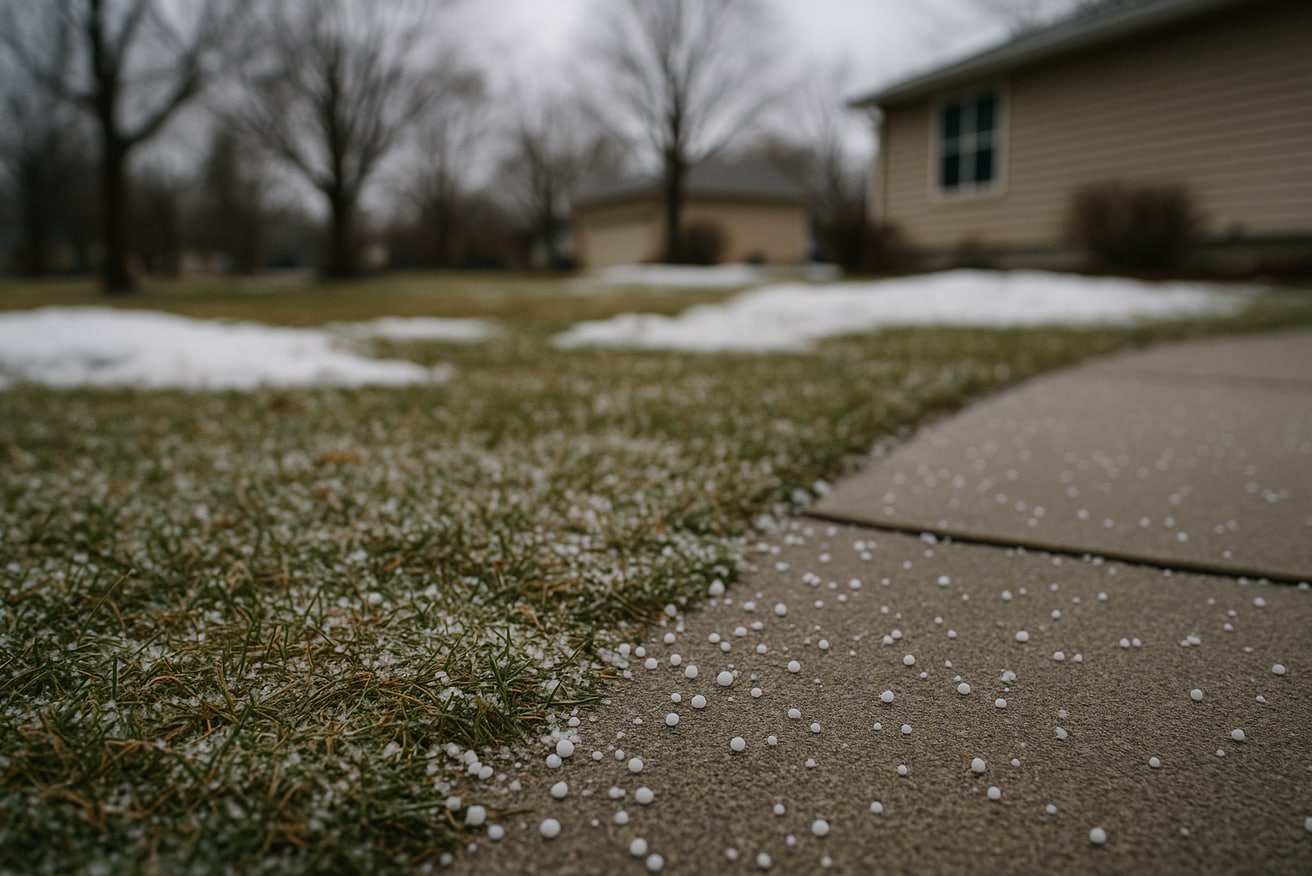
February 27 did not feel like February. It was an unseasonably warm day for late winter, and by the time the evening was over, severe thunderstorms had pushed through the northwest suburbs carrying hail, with storm damage reported mostly in Hoffman Estates and Palatine. For homeowners who associate hail with May and June, it was a strange sight — hailstones bouncing across lawns that were brown and dormant instead of green.
Illinois hail season is generally thought of as running from May through September, and that expectation shapes behavior. After a June hailstorm, people walk outside, look up at their roofs, and call for inspections. After a February hailstorm, most people shovel the strangeness of it into conversation for a day or two and move on. Off-season hail catches homeowners off guard precisely because nobody is in the habit of thinking about it.
There is also a physical reason to take winter hail seriously. Asphalt shingles are more brittle in cold weather. The asphalt that gives a shingle its flexibility stiffens as temperatures drop, so a hailstone that a warm, pliable shingle might shrug off in July can do more harm to that same shingle at the tail end of winter. A roof that has already been through years of freeze and thaw cycles has even less give to work with.
What does hail actually do to a shingle? The classic damage is a bruise: the impact crushes the fiberglass mat beneath the surface, often leaving a soft, dark spot where granules have been knocked away. Those granules are the shingle's sunscreen. Once they are gone, ultraviolet light goes to work on the exposed asphalt, and the shingle ages rapidly at each impact point. Bruised shingles rarely leak right away — the damage plays out over the following months and years, which is exactly why it gets missed. By the time a hail-battered roof starts showing bare spots or leaking, many homeowners no longer connect the problem to the storm that actually caused it.
You do not need to climb on the roof to gather evidence. Hail that is hard enough to bruise shingles usually leaves calling cards at ground level. Look closely at your gutters and downspouts for small round dents. Check the aluminum wraps around your window frames, the soffit and fascia, the mailbox, and the fins on your air conditioning unit. Dents in soft metals around the house are one of the strongest indicators that the roof above took hits too, because anything hard enough to dent aluminum did not bounce harmlessly off asphalt.
If you find that kind of evidence, take dated photos and hold onto them. Hail is a covered peril under standard homeowners insurance policies, and a claim supported by documented ground-level damage and a professional roof inspection is a much stronger claim. Keep in mind that policies typically have time limits for filing, so a February storm is not something to leave unexamined until summer.
Dynasty Restoration offers free storm damage inspections throughout the area, and our team regularly works in Hoffman Estates, Palatine, and the neighboring communities. If the February 27 storms passed over your house, a thorough inspection now will either rule out damage or catch it while the claim window is comfortably open. Either answer is worth having before the spring storm season arrives in earnest.